The Beauty Ideal in the Portrait Gallery
The beauty ideal in portrait galleries shifts with pose, dress and setting. Learn how to read each portrait in its own context, not as a universal standard.
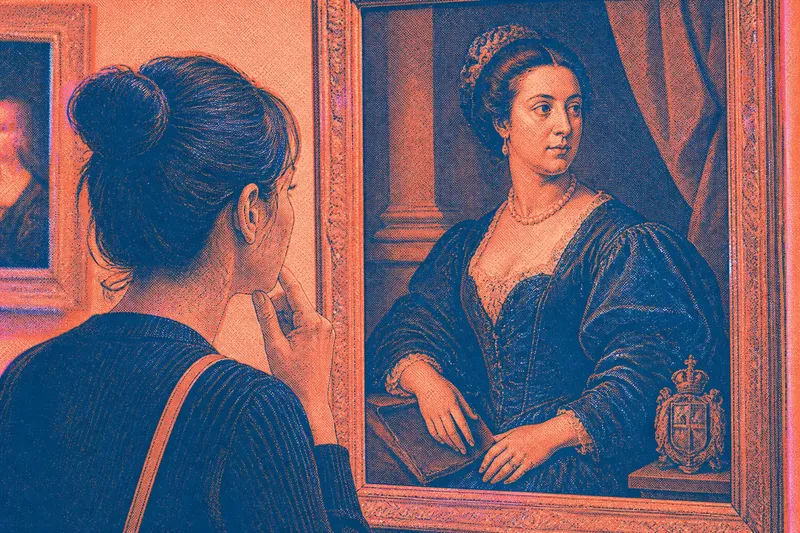
The most common mistake in a portrait gallery is to treat a composed face as a verdict on what people should look like. The beauty ideal in a portrait gallery belongs to a particular sitter, commission and social world; read it as a record of presentation, and the image becomes more informative without becoming a rule for your own appearance.
Use the situation you are in to decide what to look at. If you want to understand a formal portrait, begin with status and purpose. If a face seems unusually calm or stylised, consider the conventions of the artist’s period. If the image draws you into comparison, shift attention from features to choices of pose, clothing and setting. These routes can overlap, but each answers a different question.
When status leads
Choose this route when a portrait looks carefully arranged, with expensive-looking clothing, jewellery, a controlled pose or a room that signals authority. Ask who could commission such an image and what they wanted viewers to recognise. In many portrait traditions, beauty presentation and social position worked together: a polished appearance could communicate refinement, wealth, lineage or command.
Look first at the whole composition rather than isolating the sitter’s face. A richly worked garment, a hand resting on a book, a column, a curtain or an emblem can tell you how the sitter wished to be understood. The object is not automatically proof of a particular personality; it is evidence of the image’s intended language. A plain background, by contrast, may keep attention on the face or signal a different kind of commission.
Then notice how the body is made to occupy space. A seated figure placed centrally, a steady gaze, or an upright posture can suggest composure and authority. A turned body with the head looking back may create a different impression, such as alertness or cultivated ease. These effects come from arrangement, not from a universal formula for attractiveness.
Say you encounter an invented portrait of a merchant’s daughter, dressed in dark velvet with a small family emblem visible on a ring. You could read the fabric and emblem as signs that the painting presents family standing as well as personal appearance. The expected observable result is a more specific question—what the portrait communicates about this sitter’s position—rather than a judgement about whether her features match a timeless ideal.
When convention leads
Choose this route when several portraits share a similar expression, head angle, hairstyle or smooth treatment of the skin. Repetition can point to an artistic convention or a preferred mode of representation. It does not mean that every sitter naturally looked alike, nor that viewers in every period valued the same features.
Portraits are made images. Artists may soften, idealise or regularise a face, while patrons may expect a likeness that also presents them favourably. Hairstyles and cosmetics can be fashionable, practical or carefully symbolic. A composed expression might reflect the demands of a formal image rather than the sitter’s everyday mood.
Compare works that appear to share a convention, but keep the comparison narrow. Ask what is repeated: the tilt of the head, the direction of the gaze, a high forehead, a particular silhouette, or a calm mouth. Then ask what varies, such as age, dress, setting or the sitter’s social role. That distinction helps separate a visual habit from a claim about beauty.
Be cautious with labels such as “ideal face” when looking at a single portrait. The phrase can collapse a set of artistic and social choices into a supposed standard that everyone shared. It is more precise to say that the image presents a certain look as appropriate, desirable or elevated within its own context.
When context leads
Choose this route when the portrait’s meaning is unclear, or when the display label provides useful information about its maker, sitter, purpose or original setting. Context can change what you notice. A portrait made for a family home may address a different audience from one intended for a public or official setting.
Read the label for what it can establish, then return to the image. A name, role or commission can help explain why the sitter wears particular clothing or holds a specific object. If information is missing, keep your interpretation modest: describe visible details and distinguish them from your guesses. “The sitter wears a pearl necklace” is an observation; “the necklace proves she was vain” is not.
Consider also what the portrait leaves out. An image may privilege a formal public identity while hiding work, ordinary surroundings or relationships that do not serve its purpose. This absence does not make the portrait false. It reminds you that a portrait is a selected presentation, not a complete account of a person.
When the right interpretation depends on a label, catalogue information or the museum’s account of the work, use that information rather than treating a visual guess as fact. If the label is brief, you can still separate what you see from what you infer.
When comparison intrudes
Choose this route when you notice yourself measuring your own face against the portrait. The useful question is not whether you match the sitter, but what the image is doing: arranging light, directing attention, signalling status or shaping a likeness. That move keeps a historical image from becoming a personal scorecard.
Try naming three choices in the picture before making any judgement: the pose, the clothing and one feature of the setting. For instance, note that the sitter faces slightly away, wears a stiff collar and is placed against a dark background. This describes the portrait’s construction without deciding whether the person is beautiful by present-day standards.
It is also fine to respond emotionally. You may find a portrait appealing, unsettling, distant or tender. A personal response is real, but it is not the same as discovering a standard that applied to every viewer or every period. Keep both ideas in view: the image can affect you, and its original meanings may differ from yours.
Questions to carry
What does pose tell me?
Pose can suggest rank, composure, intimacy or movement, depending on the image’s conventions. Describe the body’s position first, then consider what that arrangement might communicate in its setting.
Does clothing define beauty?
Clothing presents the sitter through the materials, silhouette and social signals available to the portrait. It can shape an impression of elegance or status without establishing a universal ideal of appearance.
Why does the face look idealised?
The artist or patron may have preferred a flattering presentation, or the image may follow a repeated style of representation. A smooth or regularised face is not a reliable record of how all people in that period looked.
Can I compare portraits across periods?
Yes, if you compare particular choices rather than ranking faces. Notice how pose, dress and setting change, and remember that each work was made for its own audience and purpose.
What deserves attention
Spend your attention on details that sharpen the reading: the direction of the gaze, how hands are placed, the contrast between clothing and background, or an object near the sitter. These are visible clues you can check in the painting itself. You do not need to identify every symbol or assign a hidden meaning to each detail.
What is not worth the effort is trying to extract a single beauty rule from a gallery wall. A portrait can show how one person was presented, or how a group of images used related conventions; it cannot stand in for every person’s preferences across a period. Nor does a polished surface make the sitter’s appearance a more valid measure than anyone else’s.
The beauty ideal in a portrait gallery is best understood as a set of choices made visible: how a person was posed, dressed and situated for an audience. When you leave, carry one concrete observation with you, such as the way a hand or garment changes the image’s mood. That small detail is more useful than a verdict on the sitter’s face, and it leaves room for beauty to mean something different in another portrait—or to you.