A Museum Visit for Noticing What Makes an Object Beautiful
A museum visit for noticing what makes an object beautiful: follow a slow route through one room and compare shape, surface, proportion and setting.
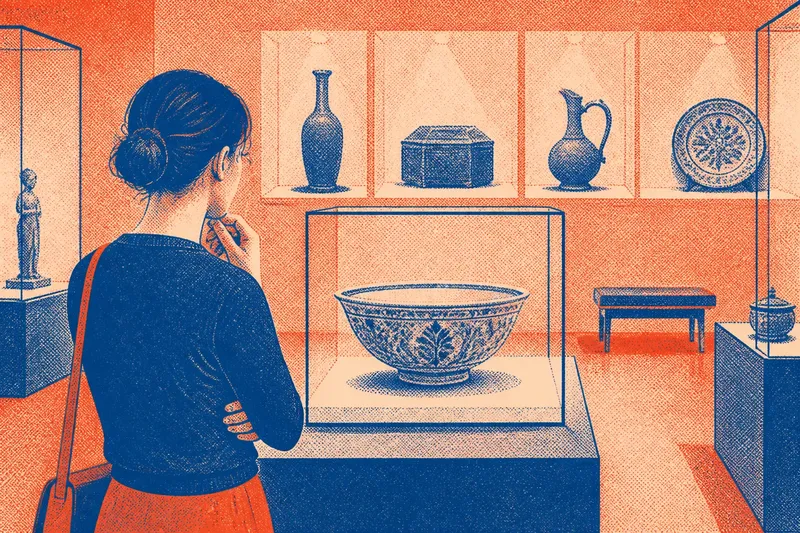
The common mistake on a museum visit is to decide too quickly that an object is beautiful—or that it is not—and move on. That snap verdict costs you the chance to notice which details drew you in, and whether the room itself helped. A museum visit for noticing what makes an object beautiful can begin with a slower question: what, exactly, is holding your attention?
Imagine you have an hour to spend in a room of decorative objects, with glass cases around the walls and a bench near the centre. You know nothing about the collection. Rather than trying to identify every object or guess what experts admire, you choose one piece and let your attention travel from its outline to its surface, proportions and surroundings. The point is not to reach a correct verdict. It is to discover how a judgement takes shape.
Choose a starting point
Stand where you can see the whole room, then let one object catch your eye. It might be a blue-and-white bowl, a carved wooden box or a small metal vessel. Do not choose the most impressive-looking piece by default. Choose the one you notice first, even if your response is uncertain or negative.
Take in its overall presence before reading the label. Is it low or upright? Compact or open? Does it seem still, balanced, lively or awkward? Use ordinary words. Specialist terms are unnecessary, and an uncertain answer is still a useful observation.
Now note your first response in a phrase, silently or in a pocket notebook: “The rim seems restless,” “The surface feels calm,” or “I cannot tell what holds this together.” Keep this initial impression brief. You are not trying to defend it; you are recording a starting point that later details may change.
Trace the shape
Look at the outline. Follow it from one edge to another with your eyes: a curve may swell gradually, tighten sharply or break into a corner. Notice where the object is widest and where its shape changes direction. If it has a handle, foot, lid or projecting edge, see how that part joins the main body.
Then compare what is present with what seems to be missing. An open bowl leaves an area of space inside it; a box closes that space away. A chair’s shape includes the gaps between its legs and back. These openings are part of the design, not blank areas to ignore.
In the imagined room, you might find that the bowl you first called plain has an outline that narrows gently towards its base. From the front, its rim looks almost level; from a slight angle, it dips. That small change gives the silhouette movement. The object has not changed, but your view of its shape has become more specific.
Stay at the permitted viewing distance, and move only where the room allows. If a case, rope or display arrangement limits your angle, treat that limit as part of the visit rather than trying to peer around it.
Read the surface
Next, look at how the surface catches or absorbs light. Does it appear glossy, matte, uneven, polished, patterned or worn? A surface can draw attention through contrast: a bright edge against a dull body, a repeated motif interrupted by a plain patch, or a smooth area beside visible tool marks.
Try looking at the object from another place in the room, if the layout permits. A glaze may flash from one angle and settle into a quiet tone from another. A carved line may seem shallow at first, then cast a more distinct shadow as your position changes. You do not need to know how the object was made to notice what its finish does to your eye.
Be cautious about turning a visible mark into a story. A patch might be damage, repair, decoration or simply the way the light falls. Without reliable information, describe what you can see rather than guessing at its cause. “A dark line crosses the side” is an observation; “the maker intended it to look aged” is a claim you cannot establish from appearance alone.
Compare the proportions
Now compare the parts with one another. Does the handle look small beside the body, or does it balance it? Is the foot broad enough to make the upper part seem steady? Does decoration occupy most of the surface, or leave open space around the form?
There is no single proportion that makes an object beautiful. A narrow neck above a broad body may feel graceful to one visitor and top-heavy to another. The useful question is how the relationship affects your response. Does one part pull your eye away from the rest? Does a repeated shape make the object feel coherent, or does a surprise give it character?
In your imagined visit, the bowl’s foot may seem unusually small. Rather than treating that as a flaw, look again at the broad curve above it. The contrast could make the bowl appear poised, as if its weight were gathered carefully at the centre. Or it may continue to feel precarious to you. Either response can be precise without becoming a universal rule.
Notice the room
Step back enough to include the display around the object. Consider its height, the colour behind it, the lighting and the pieces nearby. A dark vessel against a pale wall may seem more dramatic than the same vessel among objects of similar colour. A large case can make a small ornament feel isolated; a close group can make it seem part of a family.
Ask whether the setting is helping you see a detail or steering your attention. A spotlight may bring out a shine while making a matte area harder to read. A label placed beside an object can frame it as important before you have decided what you think. Notice that influence without assuming the display is misleading. Museums must make choices about visibility, access and space, and every arrangement shapes a visit in some way.
For a useful comparison, look at one nearby object without trying to rank the two. Does it have a related shape but a different surface? Does it feel quieter because its decoration is sparse, or because it sits further from the light? You are comparing how the objects meet your attention, not deciding which one deserves it more.
Questions for slow looking?
What if nothing looks beautiful?
Keep going with description rather than forcing admiration. You may notice an appealing curve, an unusual texture or a relationship between parts even if the whole object does not suit your taste.
Should I read the label first?
Either order can work, but looking first gives you a chance to record an unprompted response. Read the label afterwards for information about the object, and keep that information separate from details you observed yourself.
Can I take notes or photographs?
Follow the museum’s posted rules, which can differ between rooms and objects. A few words in a notebook may be enough; a photograph can flatten changes in light and angle that were noticeable in person.
How do I compare objects fairly?
Compare one feature at a time, such as outline or finish, while remembering that different objects may have had different uses. The aim is not to judge them by identical standards but to see how their features shape your response.
Return to your first impression
Before leaving the room, look once more at the object you chose. Read its label if you have not already, then return your attention to its visible form. Has your first phrase changed? Perhaps “plain” has become “restrained”; perhaps the surface now seems more interesting than the shape. It is also possible that your verdict remains unchanged, but you can explain it more clearly.
Say you arrived thinking a small wooden box looked dull. After following its outline, noticing a smooth lid beside a textured body, and seeing how the display light picked out one edge, you might leave calling it quiet rather than dull. That is not a discovery about what everyone should admire. It is a more exact account of what altered your own attention.
What is not worth the effort is trying to assign every object a score, or hunting for one hidden feature that proves it is beautiful. A room is not an exam, and a changing response is not a failure of taste. If you want to extend the visit, choose a second object and repeat just one part of the route—perhaps tracing its outline—so the comparison stays manageable.
A museum visit for noticing what makes an object beautiful works best when you leave room for uncertainty. The next time a piece attracts or repels you, pause on one visible detail before naming the whole. That small delay can turn a quick verdict into a richer way of looking.